
Summary
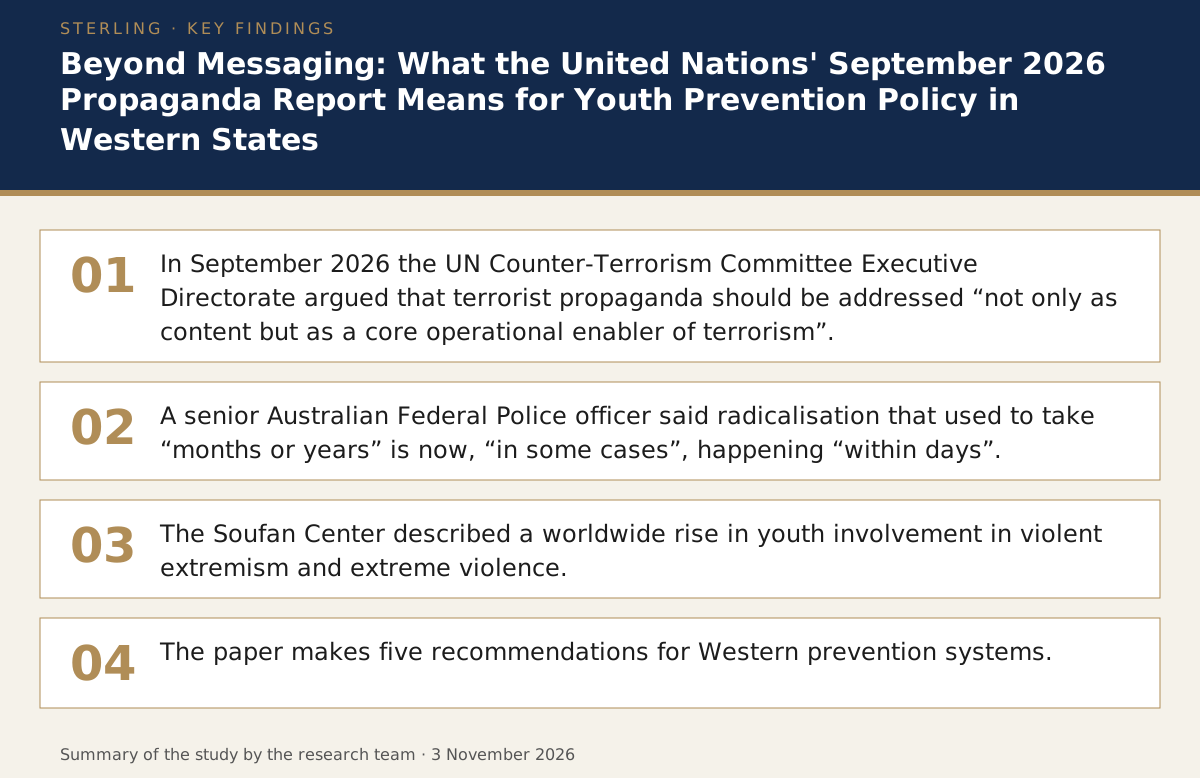
In September 2026 the United Nations Security Council Counter-Terrorism Committee Executive Directorate published a Trends Report arguing that terrorist propaganda should be addressed "not only as content but as a core operational enabler of terrorism" (Counter-Terrorism Committee Executive Directorate 2026, sec. II, 6). Within weeks, three further public signals pointed the same way. On 20 October the European Commission's Directorate-General for Migration and Home Affairs reported on an EU-funded project that has built a tool to help police detect recruitment in gaming spaces (Directorate-General for Migration and Home Affairs 2026). On 21 October a senior Australian Federal Police officer told a parliamentary committee that radicalisation which used to take "months or years" is now, "in some cases", happening "within days" (Parliament of Australia 2026, 14ff.). The same day, The Soufan Center described a worldwide rise in youth involvement in violent extremism and extreme violence (The Soufan Center 2026).
This paper does not repeat the centre's earlier work on arrest figures or on individual platforms. It asks a narrower question: what should Western governments change in their prevention systems now that the United Nations itself describes propaganda as operational infrastructure that increasingly targets children? We make five recommendations.
1. What is new in the September 2026 Trends Report
The report, titled Beyond Messaging: Terrorist Propaganda as Operational Infrastructure, identifies five emerging trends: the use of artificial intelligence, the exploitation of gaming and alternative online spaces, gore and nihilistic content, ideological convergence, and the increased targeting of children and young people (Counter-Terrorism Committee Executive Directorate 2026, sec. III, 6–15). Four findings matter most for Western policy.
Propaganda is now tied to financing. The report describes propaganda as "the trust infrastructure through which terrorist financing can scale". Citing the thirty-seventh report of the United Nations Analytical Support and Sanctions Monitoring Team, it notes that the Islamic State in Iraq and the Levant-Khorasan Province has embedded Monero and bitcoin wallet addresses and QR codes in its Voice of Khorasan publication (Counter-Terrorism Committee Executive Directorate 2026, sec. II, 5).
Gaming spaces are a distinct regulatory gap. The report names Discord, Twitch and Steam as "a significant and underregulated channel" (Counter-Terrorism Committee Executive Directorate 2026, sec. III, 8), and observes that much gaming-related extremist content is "awful but lawful": extreme, yet below the threshold for removal under platform policies or national law (Counter-Terrorism Committee Executive Directorate 2026, sec. III, 9).
Ideology is fluid. Drawing on research by the Directorate's Global Research Network partners, the report finds that for some younger recruits violence "functions less as the product of ideological commitment than as its starting point" (Counter-Terrorism Committee Executive Directorate 2026, sec. III, 12). It concludes that counter-terrorism frameworks designed around clearly defined ideological groups are "increasingly ill-suited" to the current threat landscape (Counter-Terrorism Committee Executive Directorate 2026, sec. V, 24).
Youth recruit youth. Citing its October 2025 Trends Alert on the terrorist exploitation of children, the Directorate describes how groups motivated by xenophobia, racism and other forms of intolerance, or in the name of religion or belief, particularly those active in gaming spaces, have pioneered a "youth-on-youth" recruitment model in which teenage recruits draw in their peers. It also notes the use of "culturally fluent recruiters" whose messaging is hard to tell apart from mainstream youth content (Counter-Terrorism Committee Executive Directorate 2026, sec. III, 15).
The report also warns of an "acceleration gap" between the speed at which terrorist actors adapt and the longer timelines of legislation and policy (Counter-Terrorism Committee Executive Directorate 2026, sec. V, 22).
2. Corroborating signals from October 2026
Australia. On 21 October the Parliamentary Joint Committee on Intelligence and Security took evidence for its Inquiry into the Nature and Drivers of Radicalisation in Australia. - The Acting Deputy Commissioner for National Security Investigations of the Australian Federal Police said that radicalisation "used to take months or years" but "now, in some cases, it is happening within days". She attributed this to artificial intelligence, "a growing grievance generation", young people searching for purpose and belonging, and the sophistication of online networks (Parliament of Australia 2026, 14ff.; Australian Federal Police 2026). - An Assistant Commissioner of the Australian Federal Police told the committee that since 2020, 65 young people under 18, the youngest aged 12, had been the subject of its operations, and that 35 had been charged with state or Commonwealth terrorism-related offences (Parliament of Australia 2026, 14ff.). - The Australian Security Intelligence Organisation said artificial intelligence "has been used to enable attack planning" and "can bypass hours of work" (Parliament of Australia 2026, 14ff.). - The Department of Home Affairs said that as at 30 June 2026, 30 per cent of participants in Australia's countering violent extremism programmes were aged 17 or under, and that the youngest participant had been 11. Officials said referrals come predominantly from law enforcement and corrections, and the department's counter-terrorism coordinator said "we are picking too many people up too late in the piece" (Parliament of Australia 2026, 26ff.; Tregenza 2026). - According to the Australian Broadcasting Corporation, the Australian Federal Police is considering seeking powers to disrupt harmful chat groups more overtly, including by posting messages alerting users that police are present (Tregenza 2026). In evidence, this was described as a proposal still needing a feasibility study (Parliament of Australia 2026, 14ff.).
European Union. The GEMS project (Gaming Ecosystem as a Multilayered Security Threat), coordinated by Trinity College Dublin, received EUR 2,864,352 under the Civil Security for Society cluster of Horizon Europe and ran from 1 September 2023 to 31 August 2026 (CORDIS 2026a). It developed a tool called Watchtower to help analysts monitor public chat on services such as YouTube Live, Twitch, Reddit and Discord, which is being tested with the Irish police and other European partners. In the Commission's summary, extremist discourse in gaming "often appears in the form of everyday discriminatory language rather than overt propaganda", and gaming spaces can act as "a filtering stage" before users are moved to less moderated or encrypted platforms (Directorate-General for Migration and Home Affairs 2026). The project's own reporting adds an important caveat. Its analysis of Steam, Discord and other platforms found extremist material "relatively limited in volume and only indirectly linked to gaming platforms and play", and it warned against "over-interpreting aesthetic similarities with shooter games" (CORDIS 2026b).
Wider pattern. The Soufan Center reported on 21 October that the average age of perpetrators affiliated with the online networks known as the Community (COM) and the True Crime Community ranges between 11 and 22, and that over the previous six months a growing number of True Crime Community attackers and plotters had been under 15 (The Soufan Center 2026).
These signals concern several ideologies, not only Islamist ones. The Directorate cites cases in which young perpetrators drew on neo-Nazi imagery, pro-Da'esh content and mass-shooter glorification at the same time (Counter-Terrorism Committee Executive Directorate 2026, sec. III, 12–13).
3. Implications for Western governments
- Prevention referral systems are tuned to ideology; the threat increasingly is not. Where referral criteria require an identifiable ideology, mixed or unclear cases risk falling through. The Directorate reports, as an emerging good practice, that some law enforcement and intelligence services prioritise cases involving "mixed or hybrid violent extremist narratives" in threat assessment (Counter-Terrorism Committee Executive Directorate 2026, sec. V, 27).
- Referrals arrive late. The Australian evidence that referrals come predominantly from law enforcement and corrections (Parliament of Australia 2026, 26ff.) is a warning for any system that relies on the justice system as the first point of contact.
- "Awful but lawful" content sits between regimes. The Directorate notes that counter-terrorism, online safety and gender-based violence prevention frameworks operate under distinct legal, policy and institutional arrangements, so gaps "in detection, attribution and response" can emerge (Counter-Terrorism Committee Executive Directorate 2026, sec. V, 23).
- Counter-financing and counter-propaganda work in silos. The report, citing the Financial Action Task Force, notes that platform enforcement focuses on content removal while capabilities to identify and disrupt terrorist financing are "still being developed" (Counter-Terrorism Committee Executive Directorate 2026, sec. V, 27).
- Blunt measures carry costs. The Directorate cautions that national platform bans can feed narratives of state censorship, citing Somalia's 2023 ban on Telegram and TikTok (Counter-Terrorism Committee Executive Directorate 2026, sec. V, 24). It also warns that blanket age restrictions without robust verification may leave the most vulnerable young people with fewer protections (Counter-Terrorism Committee Executive Directorate 2026, sec. V, 25).
4. Recommendations
- Commission a review of prevention referral thresholds to make sure that young people showing fascination with violence, but no coherent ideology, can be referred and supported.
- Build earlier referral routes through schools, parents and youth services, with clear guidance on the warning signs the Directorate describes: gamified content, gore, and in-group "banter" that normalises hate. Guidance should reflect the GEMS finding that extremist material in gaming spaces is limited in volume and mostly indirect, so that ordinary gaming is not treated as a risk factor in itself.
- Assess tools such as Watchtower for lawful use by police on public gaming-adjacent chat, with published safeguards on privacy, oversight and human review, before any national roll-out.
- Link counter-terrorism financing teams with online harms teams, so that wallet addresses and payment links embedded in propaganda are treated as financial intelligence and not only as content to remove.
- Coordinate internationally on youth cases. Western states should share anonymised case typologies on youth-on-youth recruitment through existing practitioner networks, which the Directorate lists among emerging good practices.
5. Limits of this paper
- The Trends Report's regional analysis draws mainly on cases from Africa and Central and South Asia (sec. IV, 16–21). Its findings on gaming and youth are general, not specific to any Western state.
- Australian evidence has been checked against the committee Hansard as displayed on ParlInfo. Only each fragment's starting page (14 and 26) is available; exact pages need confirming from the Hansard PDF before any further use.
- GEMS findings rest on the Commission's news article and the project's CORDIS reporting (the periodic report covers 1 September 2023 to 28 February 2025), not on the project's full deliverables.
References
Australian Federal Police. 2026. "AFP Acting Deputy Commissioner National Security Investigations Sandra Booth Opening Statement." Media statement, 21 October 2026. https://www.afp.gov.au/news-centre/media-statement/afp-acting-deputy-commissioner-national-security-investigations-sandra.
CORDIS. 2026a. "Gaming Ecosystem as a Multilayered Security Threat (GEMS)." Fact sheet, grant agreement 101121345. European Commission. https://doi.org/10.3030/101121345.
CORDIS. 2026b. "Gaming Ecosystem as a Multilayered Security Threat (GEMS): Periodic Reporting." European Commission. https://cordis.europa.eu/project/id/101121345/reporting.
Counter-Terrorism Committee Executive Directorate. 2026. Beyond Messaging: Terrorist Propaganda as Operational Infrastructure. CTED Trends Report. New York: United Nations Security Council Counter-Terrorism Committee, September 2026. https://www.un.org/securitycouncil/ctc/sites/www.un.org.securitycouncil.ctc/files/cted_trends_report_terrorist_propaganda_september_2026.pdf.
Directorate-General for Migration and Home Affairs. 2026. "GEMS: An EU-Funded Project Tackling Radicalisation in Online Gaming Spaces." European Commission, 20 October 2026. https://home-affairs.ec.europa.eu/news/gems-eu-funded-project-tackling-radicalisation-online-gaming-spaces-2026-10-20_en.
Parliament of Australia. 2026. Parliamentary Joint Committee on Intelligence and Security: Inquiry into the Nature and Drivers of Radicalisation in Australia. Committee Hansard, 21 October 2026, 14ff. (Australian Federal Police and Australian Security Intelligence Organisation) and 26ff. (Department of Home Affairs). https://parlinfo.aph.gov.au/parlInfo/search/display/display.w3p;query=Id%3A%22committees%2Fcommjnt%2F30024%2F0002%22 and https://parlinfo.aph.gov.au/parlInfo/search/display/display.w3p;query=Id%3A%22committees%2Fcommjnt%2F30024%2F0003%22.
The Soufan Center. 2026. "As the Youth Radicalization Crisis Spreads, International Coordination Is Required." IntelBrief, 21 October 2026. https://thesoufancenter.org/intelbrief-2026-october-21/.
Tregenza, Holly. 2026. "Australia at 'Crossroads' as Police Warn of 'Tsunami' of Youth Radicalisation Online." ABC News (Australian Broadcasting Corporation), 21 October 2026. https://www.abc.net.au/news/2026-10-21/youth-radicalisation-crime-police-warning-ideological-violence/107292752.